

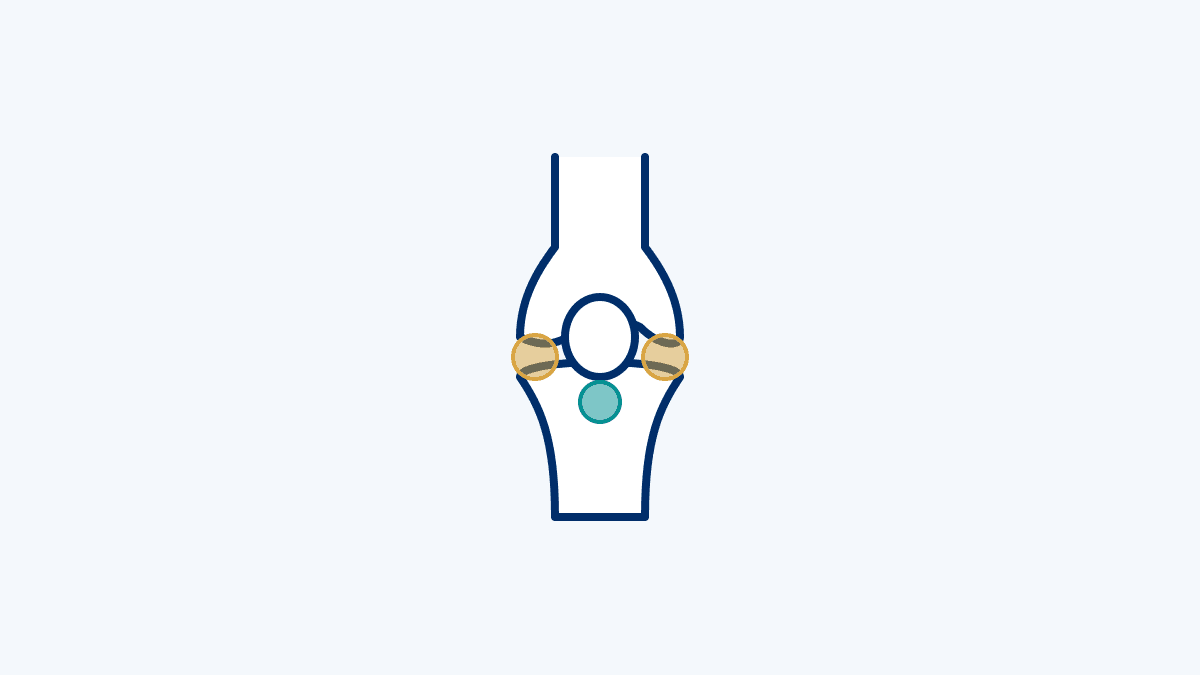
When knee pain needs urgent attention
Come in the same day if the knee is hot, very swollen and severely painful, especially with fever — that can be joint infection. Also come in urgently after an injury if you cannot bear weight, the knee gave way completely, or it is visibly deformed.
When knee pain needs urgent attention
Beyond the box above, get assessed promptly for a knee that locks and will not straighten, or one that swells rapidly within hours of an injury.
Osteoarthritis
The commonest cause in adults over 45. The cartilage cushioning the joint thins, so bone takes more load.
Typical pattern: pain that builds through the day and with use, brief stiffness in the morning that eases within half an hour, difficulty with stairs and standing up from a chair, sometimes grinding or crackling. Both knees are often involved, though rarely equally.
Weight matters more here than almost anything else — the knee carries several times body weight with each step, so losing even a few kilograms changes the load meaningfully. See arthritis for fuller detail.
Ligament injuries
Usually the result of a twisting injury, a sudden change of direction, or a fall.
- ACL injury: often a "pop" at the time, rapid swelling within hours, and a sense that the knee is unstable or gives way
- Collateral ligament injury: pain and tenderness on the inner or outer side of the knee, often after a sideways force
Not every ligament injury needs surgery. Many are managed with physiotherapy, and the decision depends on your age, activity and how unstable the knee actually is.
Meniscus tears
The menisci are the cartilage wedges that spread load across the joint. They tear either from a twisting injury in younger people, or gradually with degeneration in older knees.
Typical pattern: pain on the joint line, swelling that comes on over a day rather than minutes, catching or locking, and difficulty squatting or twisting.
Notably, degenerative meniscal tears in older knees frequently do not need surgery — physiotherapy often gives equivalent results.
Tendon and kneecap problems
- Patellar tendinopathy: pain just below the kneecap, worse with jumping or stairs, common in active people
- Patellofemoral pain: pain around or behind the kneecap, worse sitting for long periods, on stairs, or after squatting. Very common, and usually responds well to targeted strengthening
- Bursitis: a swollen, tender area over the front of the knee, often after prolonged kneeling
Inflammatory arthritis and gout
Suspect an inflammatory cause when there is prolonged morning stiffness, swelling with warmth, several joints involved, or you feel generally unwell and tired.
Gout causes sudden, intense pain with a red, hot, exquisitely tender joint — often overnight. It is treatable, and worth confirming rather than assuming.
What actually helps
For most non-urgent knee pain, in rough order of effect:
- Losing excess weight, if that applies — the highest-value intervention for knee osteoarthritis and the least often prescribed
- Strengthening the muscles around the knee, particularly the quadriceps. Counterintuitively, appropriate movement helps more than rest
- Modifying, not stopping, activity — swapping deep squatting and stairs for walking and cycling
- Pain relief, used to enable activity rather than to mask it
- Injections, where they break the pain cycle enough for rehabilitation to work
- Surgery — including knee replacement — for advanced arthritis where the rest has genuinely stopped working
Worth knowing: an X-ray showing wear does not by itself mean you need an operation. Plenty of people have marked changes on imaging and manageable knees, and vice versa.
This page is general health information, not medical advice. It cannot account for your history, medication or test results. Please speak to a qualified doctor about your own symptoms and treatment. If you think you are having a medical emergency, seek immediate help.